A Swedish “Tomte” is a must

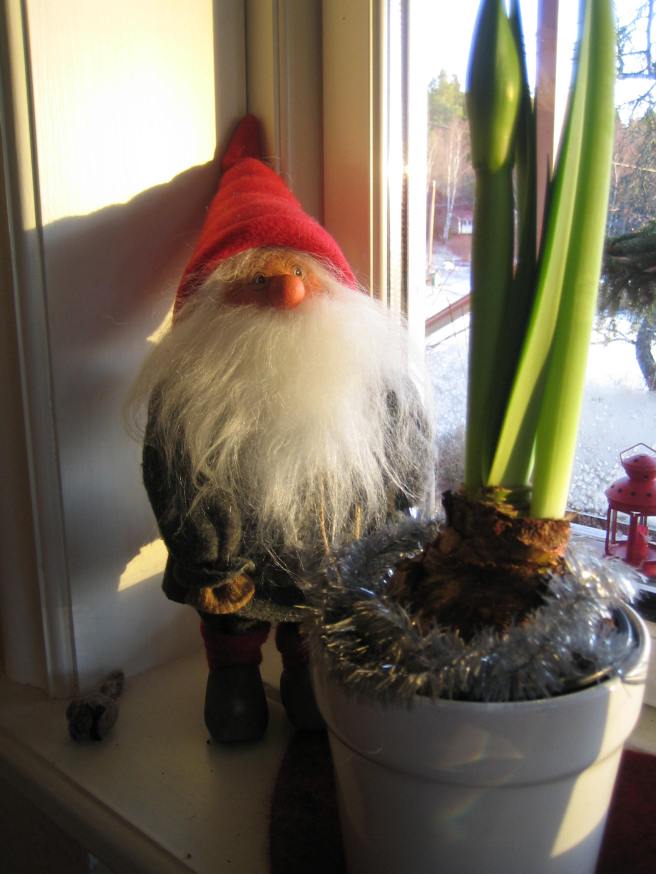
Whenever I visit The Old Town in Stockholm, especially at Christmas times, there is a shop I cannot avoid – the one with all the unique and very personal “Tomte” figures. They come in different sizes and are handmade in every detail, and you just have to have one in your home. They look a bit like Santa Claus, but the “Tomte” is, according to nordic folklore, a  sweet little figure who was supposed to guard your home and spread a good feeling in your home all year round. But he could also be quite mean, if you neglected your home or the atmosphere was bad.

The new one I bought for this year is standing in the window, right now overlooking the living room. In the old days it was said that if you were kind to each other, tended to your home and gave the “Tomte” a plate of porridge at Christmas – then he would thank you by guarding your home.

Of course, we also have the “Jultomte”, and that is Santa Claus, coming on Christmas Eve – but that is another story.

IMG_0566

What nature is offering

Two months ago, we took down a huge fir tree, it was bending dangerously towards the house. A winter storm, and it could have fallen into the roof. When I saw the long, beautiful upper branches, with its magnificent cones, I decided to save them for later. I did not know right then what to use them for, I just had the intuition it would be handy somewhere.

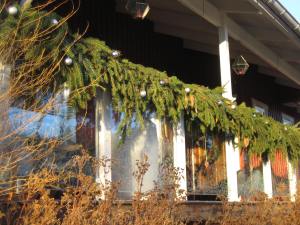
And one day the solution was right there! The upper part of the railing on

IMG_0562
Railing ready for Christmas.

our veranda is of whitepainted wood. What if I put the fir branches on top of that, tied onto it with some roughlooking string from the garden store.

With a helping hand from my husband, to hold the branches into place while I tied them, a fairy tale landscape took form. The irregularity of the branches hanging from the rail accentuated the feeling of fairy tale.

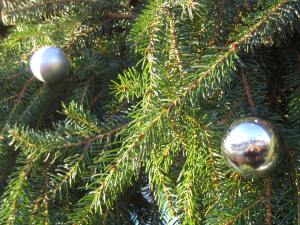
IMG_0563To finish off, I tied silvery Christmas tree balls all along the front side of the railing. For a little while I considered brightening up the whole with electric Christmas lights, but decided not to. The sharp lights would have taken away the mysterious fairy tale feeling. Enjoy 🙂

Another ice sculpture

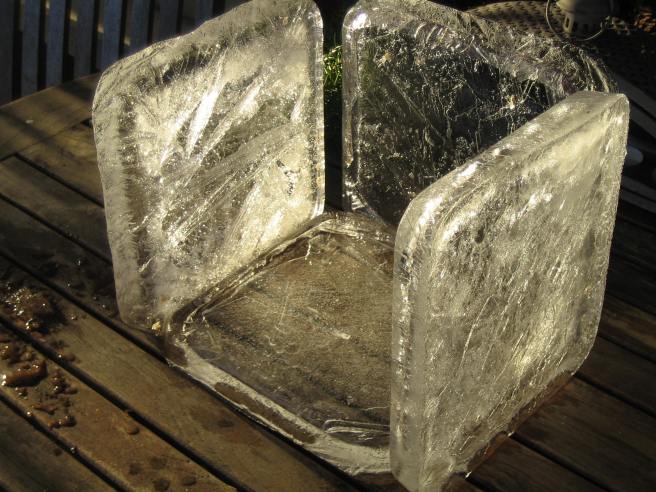
The second bird bath was smaller, but nontheless impressing when turned into an ice sculpture. On the table of the veranda, I started the building of an ice house. But, alas, the weather was against me and the ice house was never finished. You just wait until next  time the weather goes into freezing temperatures. Nontheless, with the winter sun reflecting in the ice – isn´t it beautiful?IMG_0568

Decorating for Christmas

With less than one week to Christmas, I am full of decorating inspiration. Everyone coming near me will experience that. Even the guys digging in our area for water and sewer cannot escape it 🙂 Every week I serve them a cake for their morning break – just for the fun of it – and today they got a Christmas cake decorated with delicate fir branches sprayed with the finest sugar to make it look like snow. And dotted here and there among the branches were small bulbs of marzipan colored with red eatible cooking color.  And I am so sorry, but I did not take a photo of it, before bringing it down to them, you will have to use your imagination 🙂

For the rest of December I will bring in some decorating inspiration on my blog.

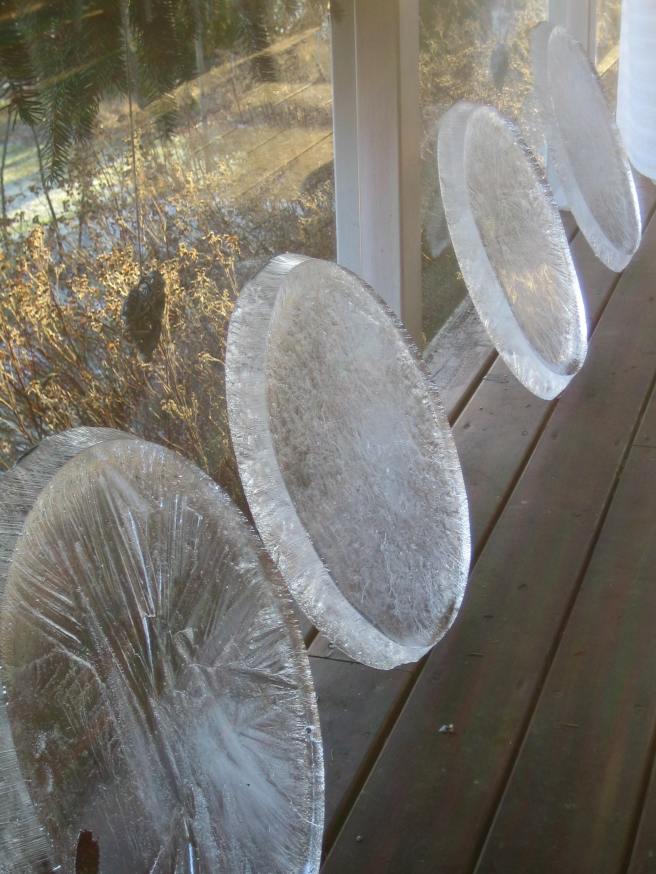
By us here in Stockholm, there have been some cold days. Every morning I feed the birds, and give them new lukewarm water. That means I take away the icy cake that has formed during the night.

I carefully remove it and place it on the veranda. After four cold nights there are now four beautiful round ice sculptures leaning towards the glass wall of the veranda. In the day, the sun reflects in it, and in the night the light from the lamps inside the living room give them a very special glow. A pity there will soon be warm weather again and they will melt. But that is life with ice sculptures … isn´t that the essence of mindfulness: to live in the moment?IMG_0571


Autumn – a time for creating

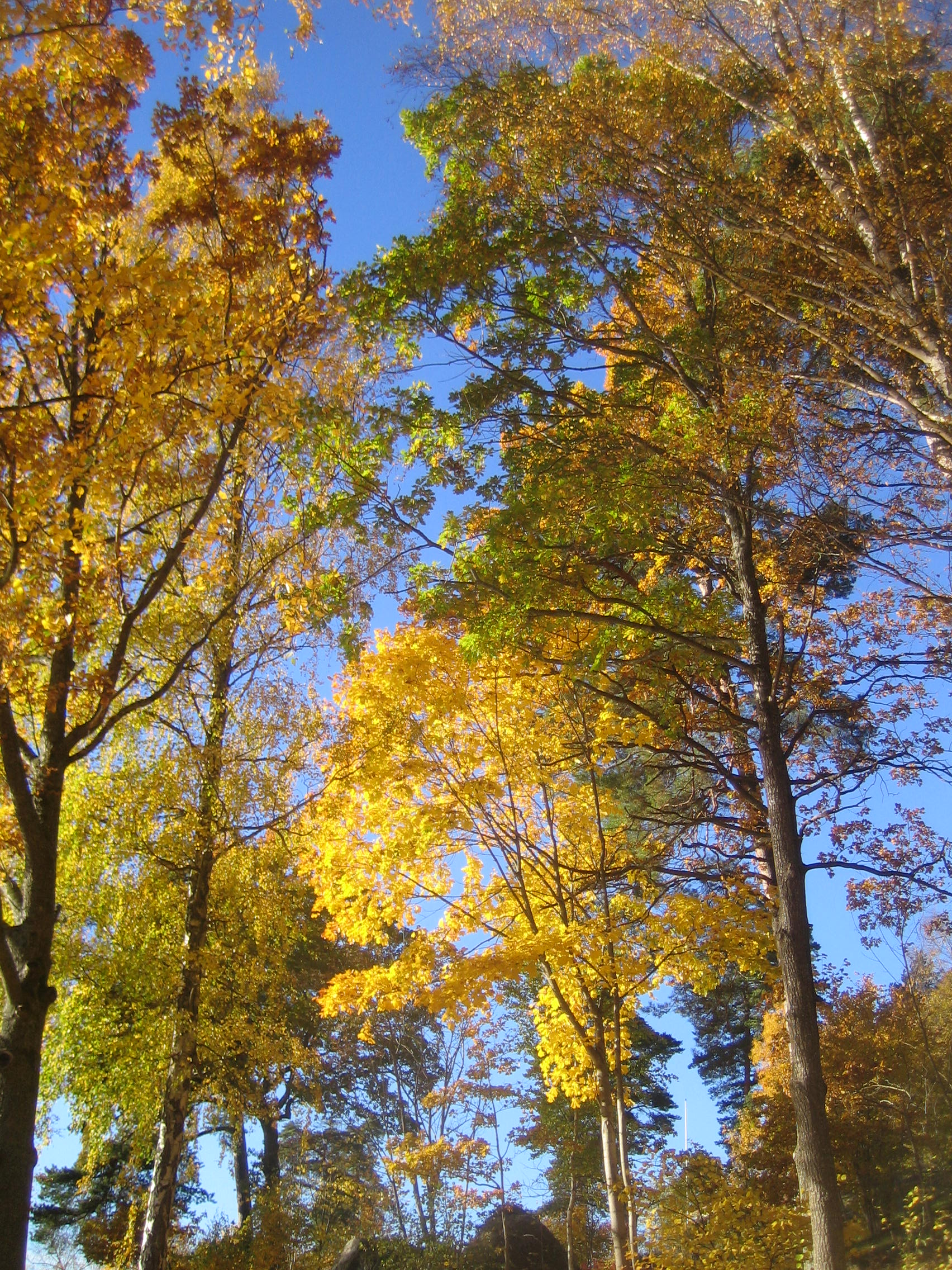
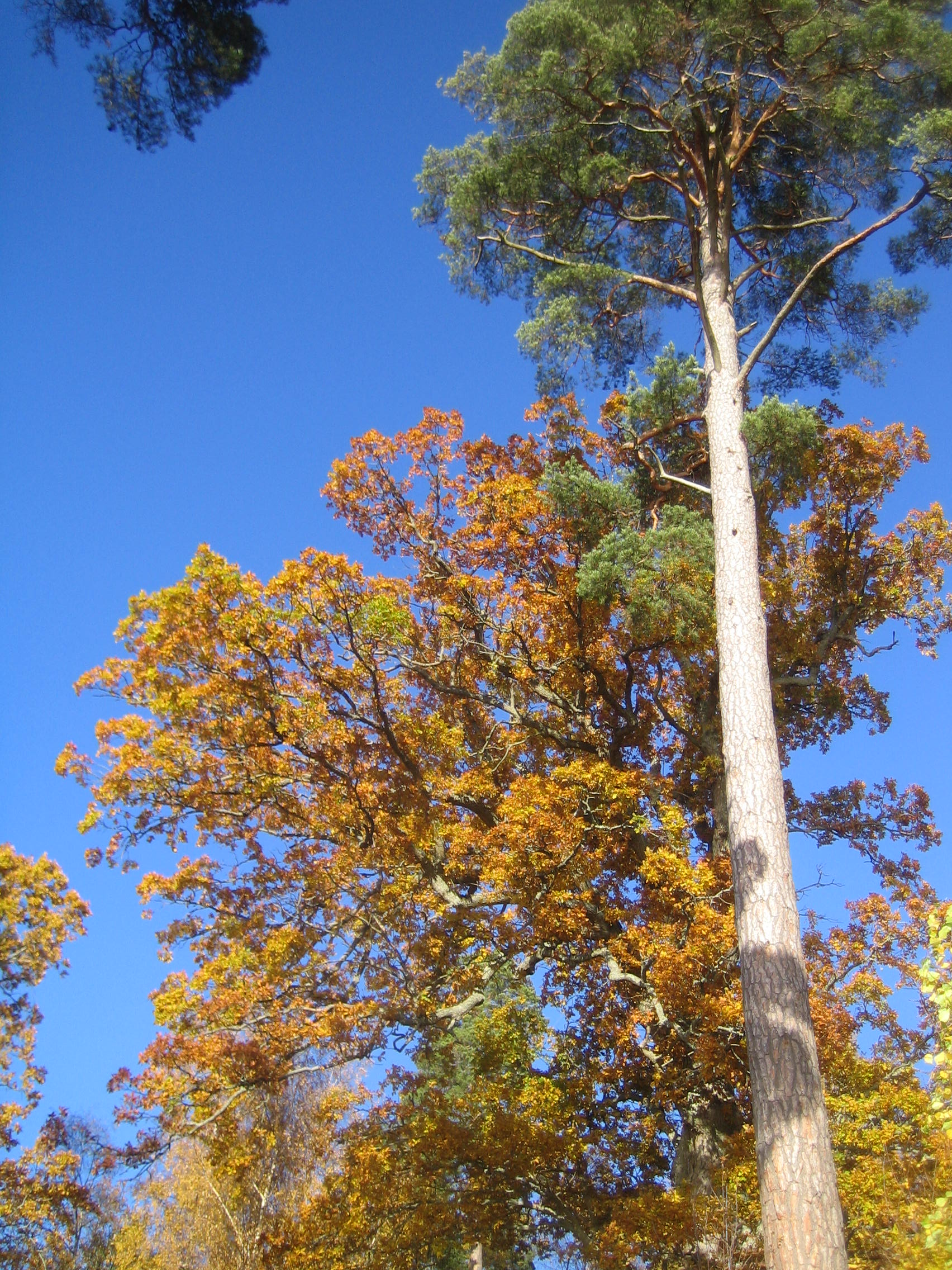
Closing down the garden, that could be a sad time. But my experience is that every season IMG_0512has its beauties and pleasures. The last few days have shown us magnificent weather with blue sky, bright yellow leaves of all kind of shades and a soft temperature. Yesterday I took a walk by the lake, admiring the huge trees by its side.

IMG_0514

IMG_0513

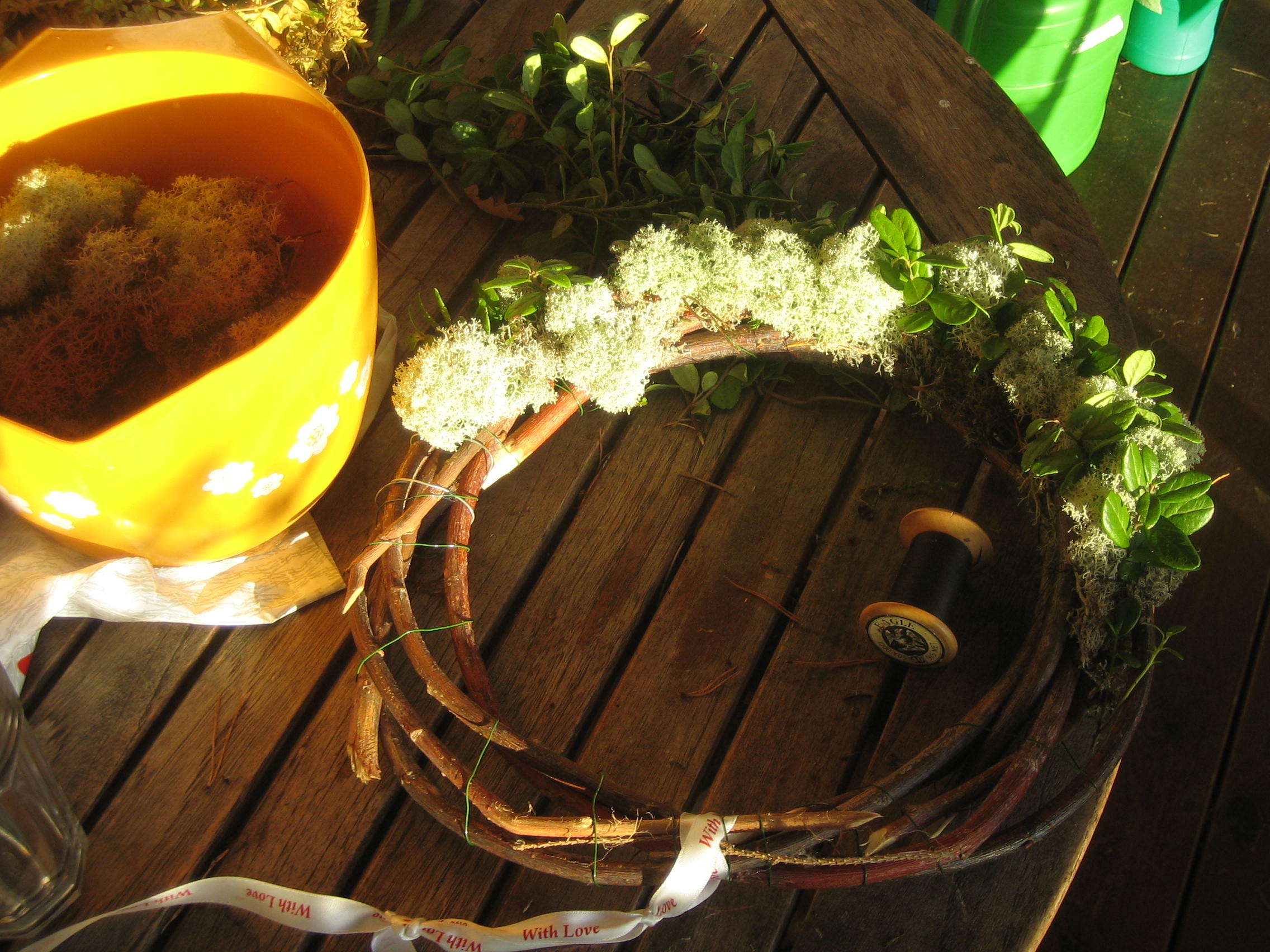
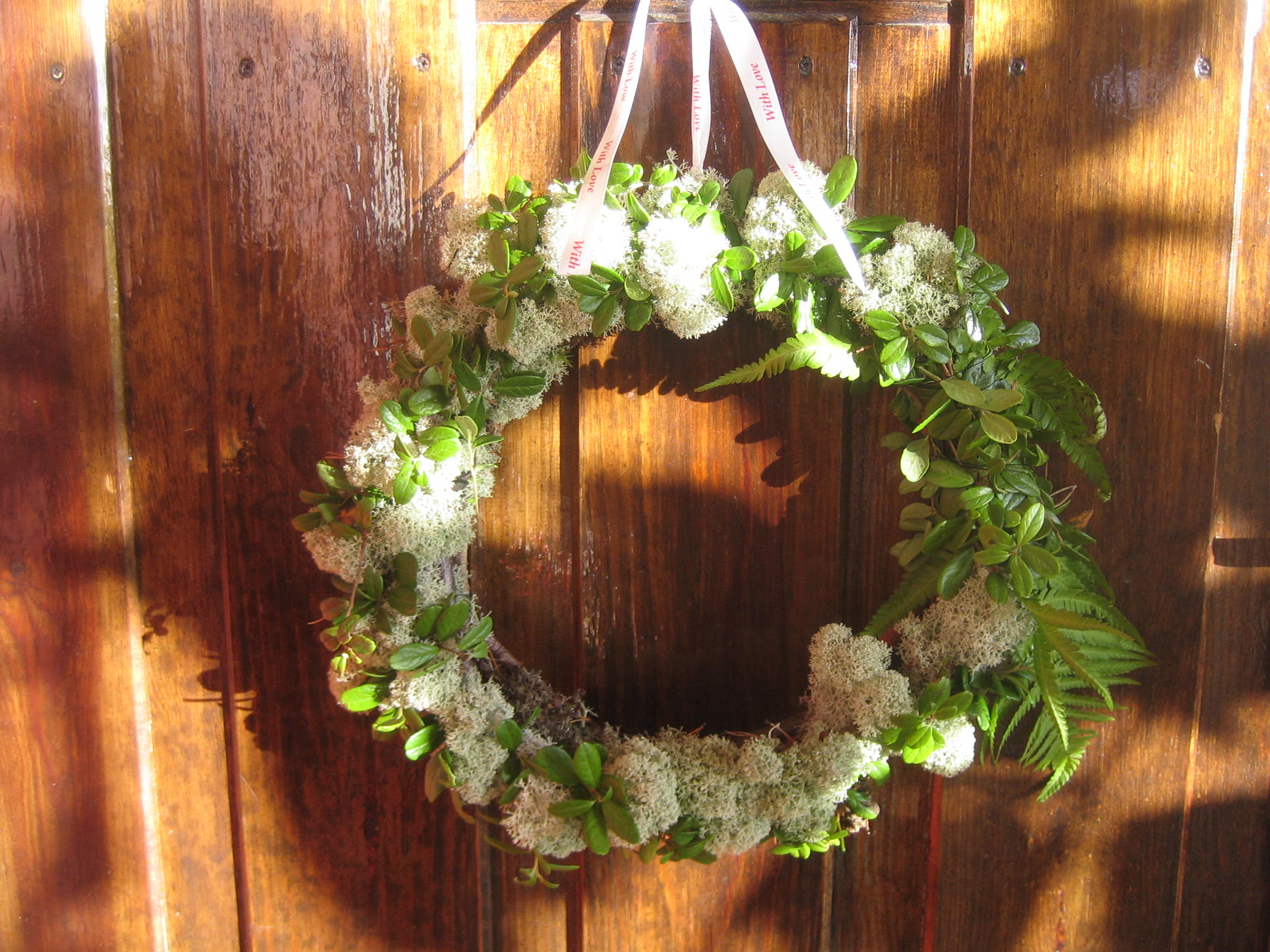
Perhaps that walk got me going, because this morning, while the morning light was still at its IMG_0526best, I started making a wreath to put on our front door for the season.

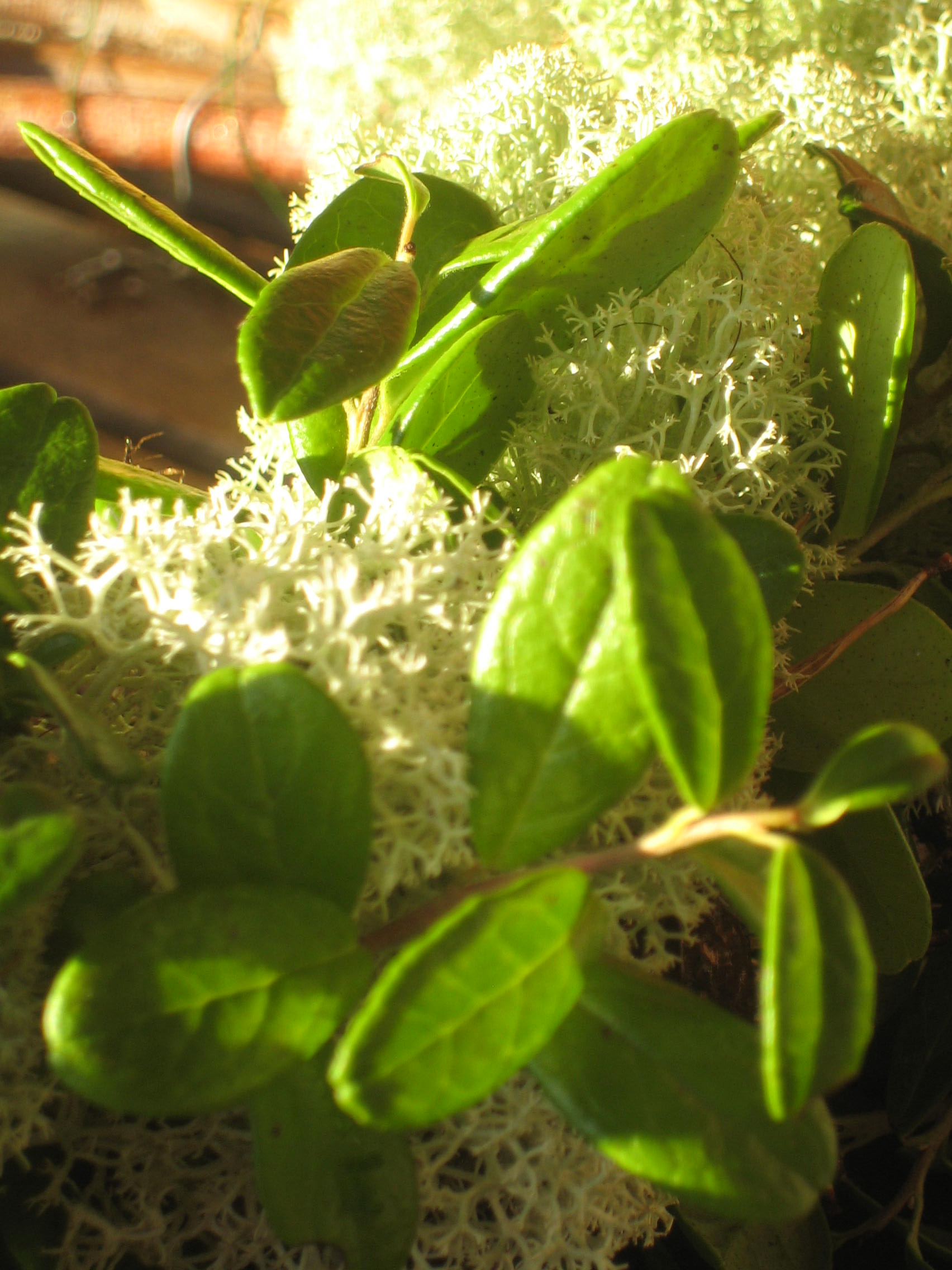
I have this base structure made of willow I once made and that I can use with different components depending on the season, to make a wreath of the season. For October and November it felt right to use lichen and lingonberry leaves.

IMG_0527I put a piece of lichen and some lingonberry leaves together and bound them to the wreath with ordinary sewing thread. A few turns with the thread, and then a new “bouquet” of lichen and lingonberry leaves. Until the whole structure was completed.IMG_0529

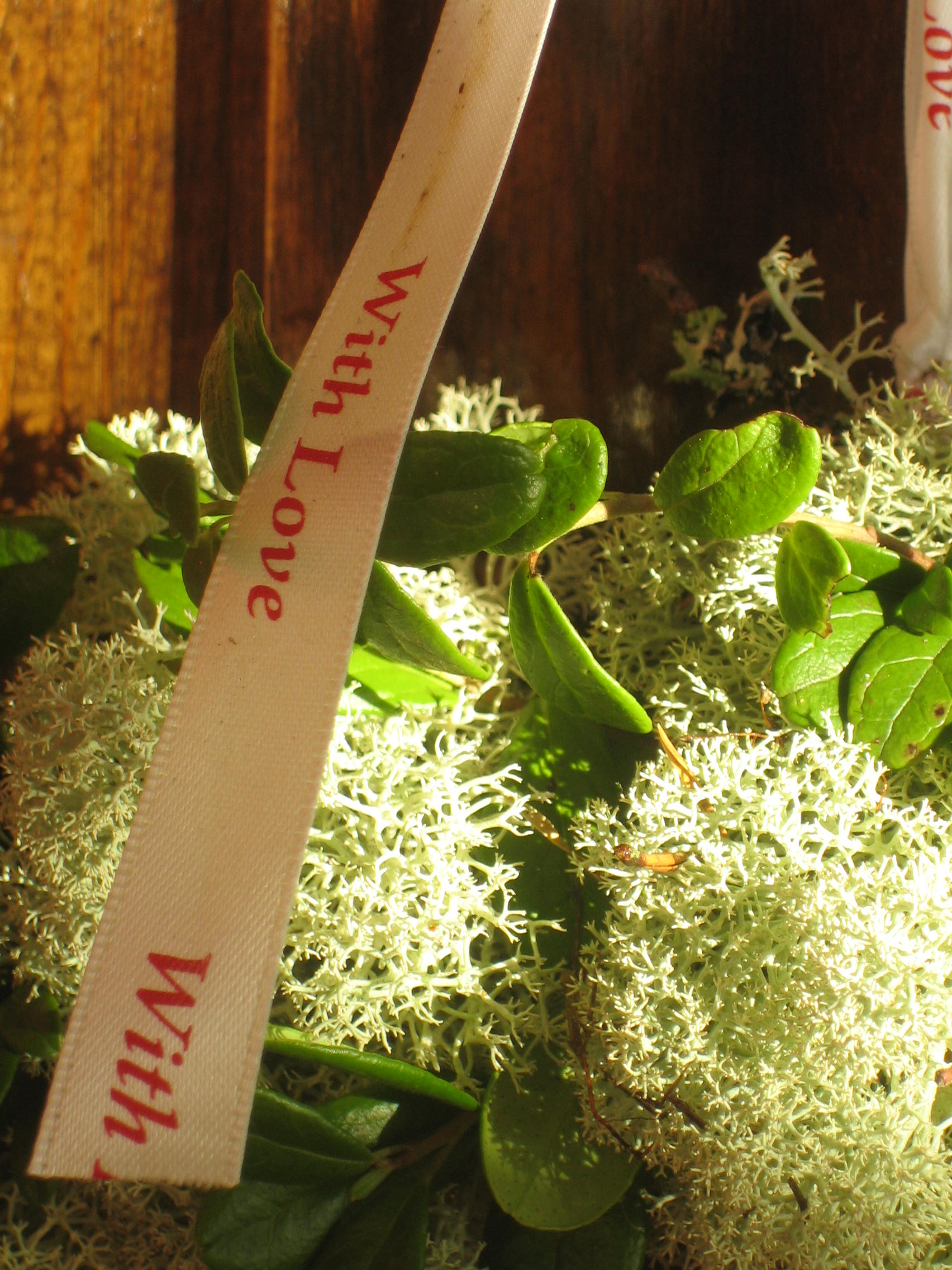
To finish it off I tied a nice ribbon “With Love” at the top and put it on our front door. Hopefully a welcoming touch to every guest.IMG_0528

An experiment…

My parsley was a gold mine last winter. I had covered it with blankets against snow and ice, and whenever I wanted some fresh parsley for cooking, I just went out and looked under the layers of blankets and could pick some. It was really amazing.

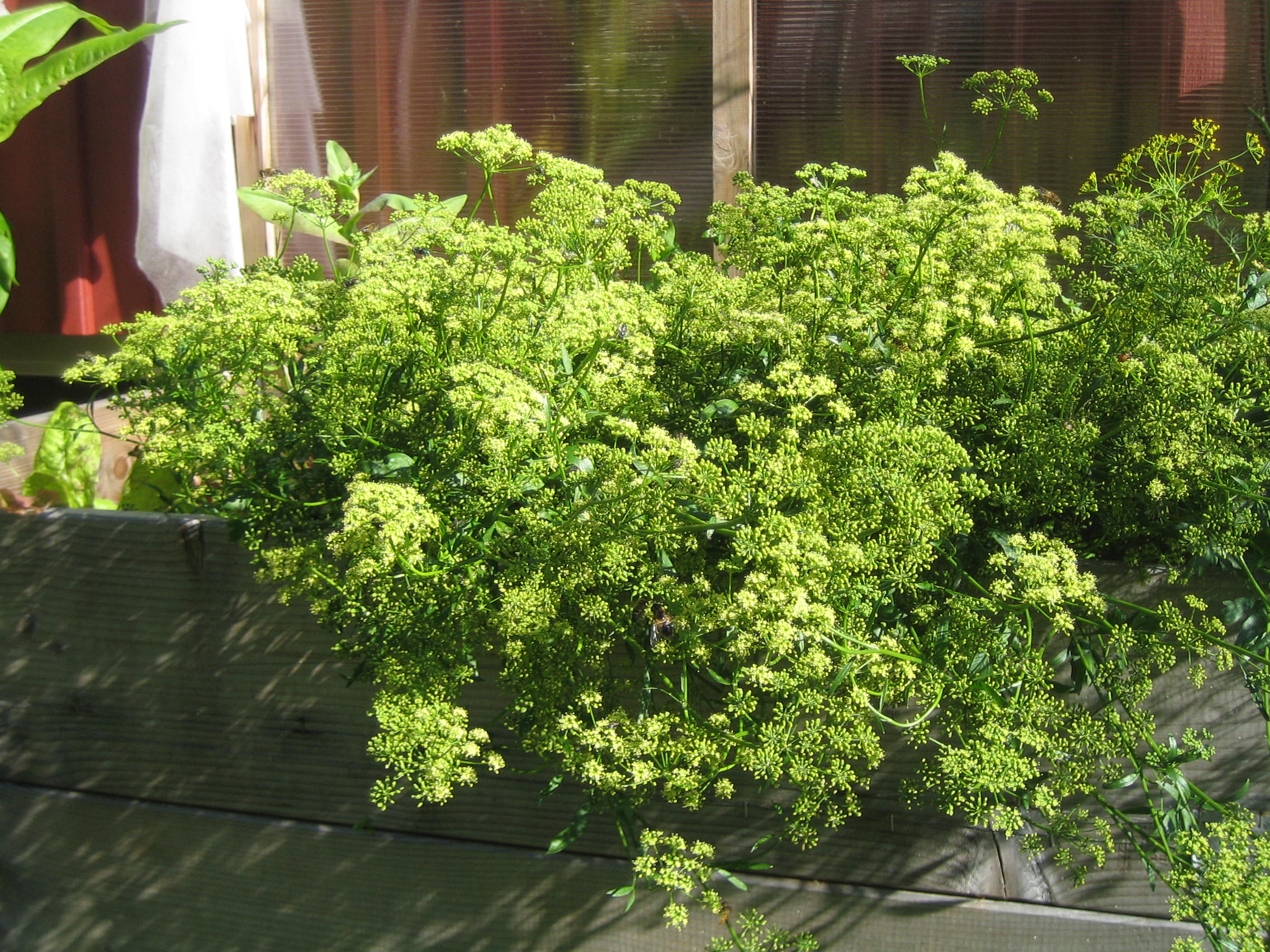
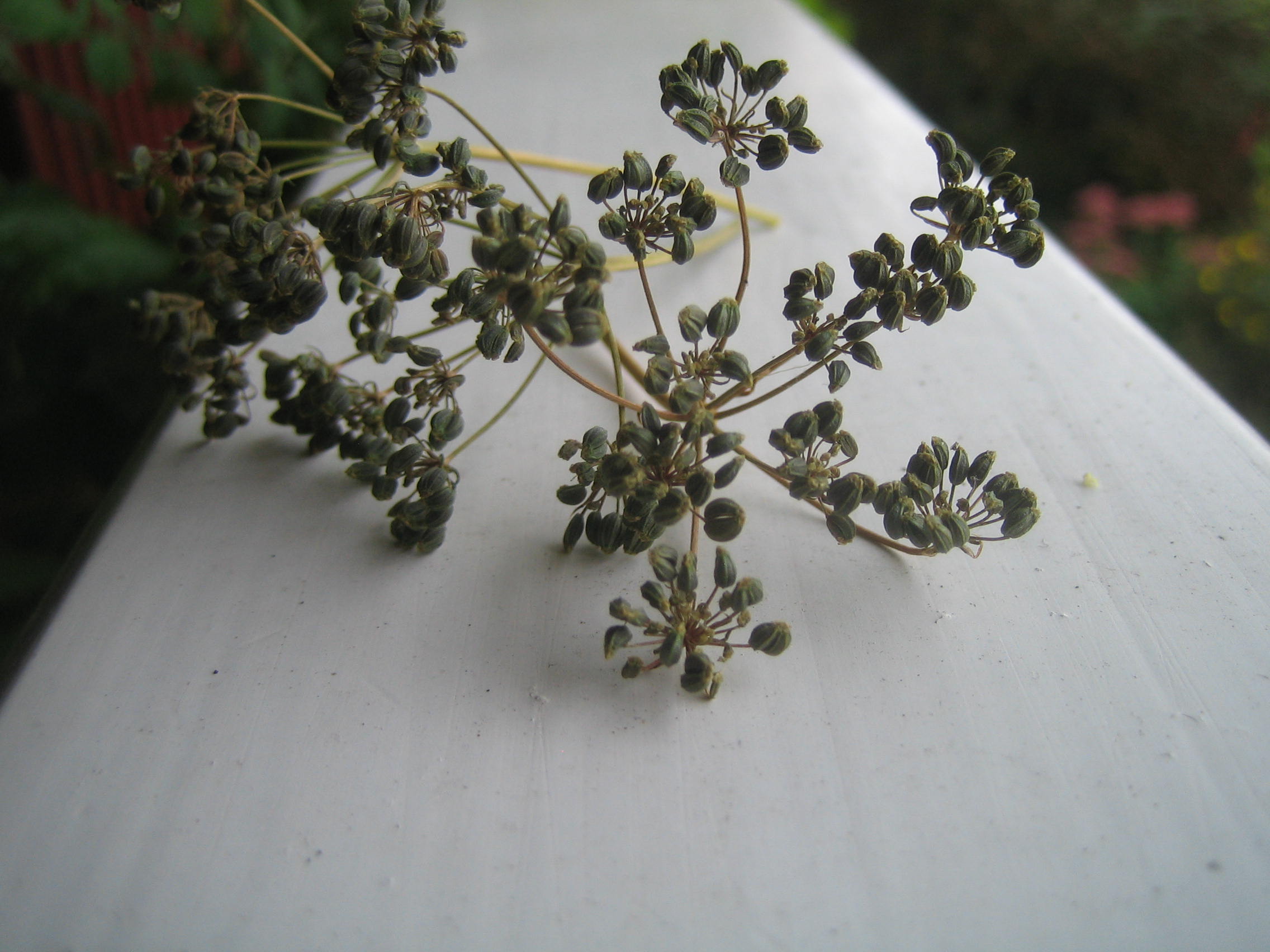
When spring came, I soon saw the parsley wanted to go blooming. Then I decided to make an experiment. What do they look like when blooming? I followed the plants developing into flowers. In the middle of the summer I had parsley flowering all over the planting place (see photo).IMG_0296

The flowers of the parsley are very, very small, and they were a gift to all the very small insects. It was sheer pleasure standing near, hearing the buzz in the air and seeing the small ones enjoying their meal 🙂

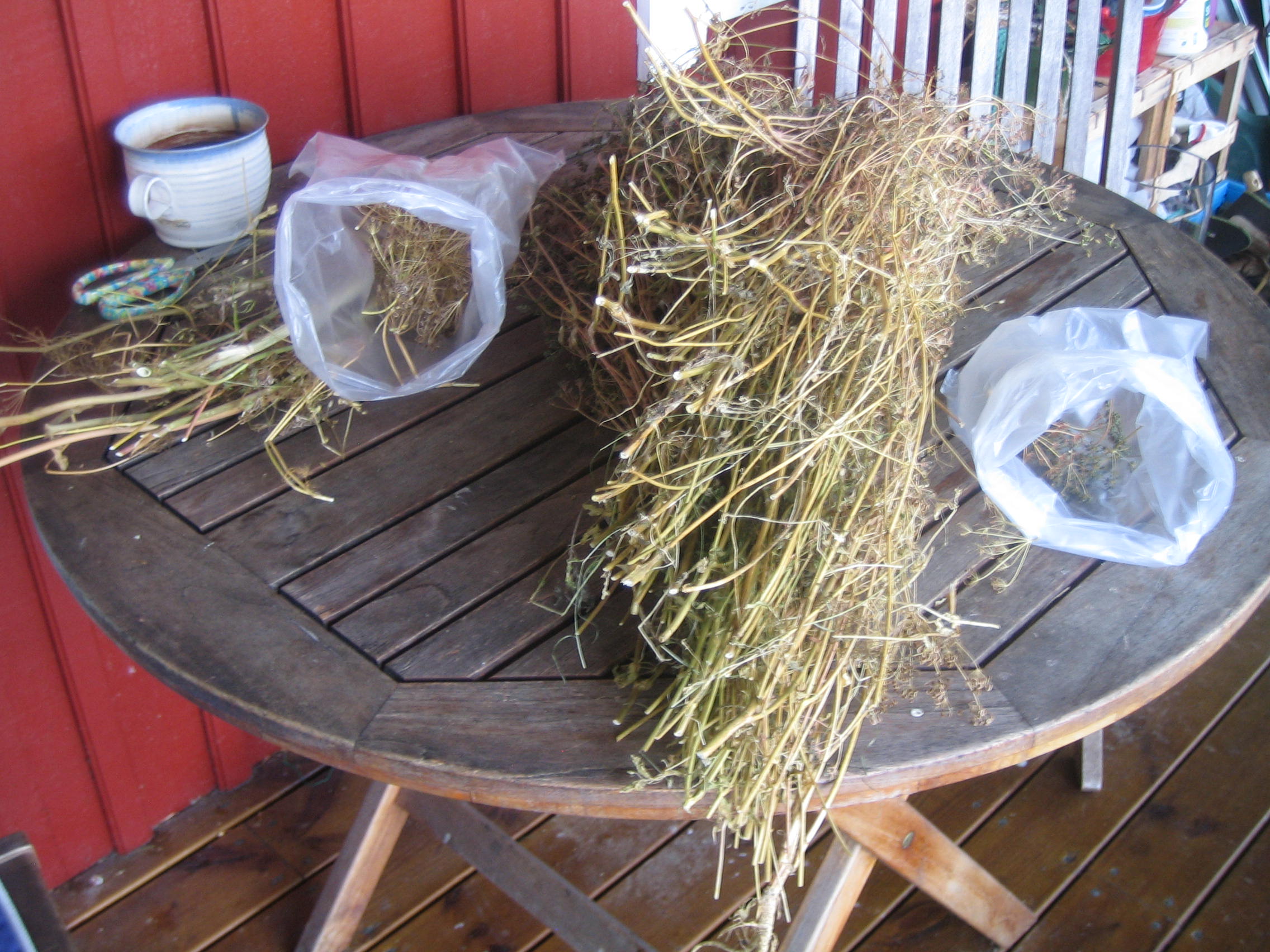
And no, I did not get any parsley to eat this season. Well, the experiment continued, and by autumn the pollinated flowers had turned into seeds. Some weeks ago I cut off the long stems and put everything to dry on the veranda.IMG_0463

IMG_0464Yesterday I saw the seeds had dried and I carefully cut off the top of the stems, with the “seed flower”. An easy way to get the seeds from the “flower” is to put the whole “seed flower” in a plastic bag. When you have filled the bag you shake, press and rub the content for a few seconds – and all the seeds fall off so you will have a nice little heap in the bottom of the bag. I learned this trick from a Norwegian writer, Annemarta Borgen, and her book “Urtehagen på knatten”.

I got so much parsley seed that I can give it away as gifts, in addition to planting parsley next season. See to that the seeds are dry, when you put them away for the winter. A nice way to store them is to fold your own “envelopes”. That is also a nice package if you want to give away seeds as gifts. Here is how to make the envelopes:

IMG_0475Choose a nice piece of paper, it should be square in size. Fold it in the middle.

IMG_0468

Fold the right and left corner into the middle, so that they overlap. IMG_0469Then insert one corner into the other, this makes the envelope hold together.

IMG_0472Open up the top angle (which consists of two layers of paper). Now you have an envelope to put the seeds in. Then fold the top angle into a lid. Fold it so that a little part of the top reaches below the bottom of the envelope. IMG_0471There you tuck it into the bottom to close the envelope.

IMG_0473

And here is your envelope, ready to give away as a gift or to store the seeds for future planting.

IMG_0474

A heart for the world

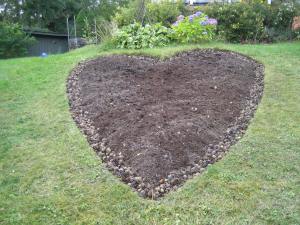
I don´t know if the heart called me, or if I called the heart, but two weeks ago I started thinking of building a heart in my garden. There is a dull slope from our veranda and down to the lawn. It´s pointing east and has a lot of sun during spring and summer season – a perfect place for a flowerbed with the shape of a heart. And what would I fill it with? Well, tulips of course, lots and lots of tulips. We Swedes are crazy about tulips, in fact we are one of the largest buyers of tulips when spring season comes. Why then? Well, I believe here in the north of Europe we are so so tired of the winter IMG_0395darkness, and when spring peaks out we want colors and colors and colors. Tulips!
I decided to build a heart of tulips. A week ago I bought lots of different sorts of red tulips at a huge garden shop north of Stockholm. Don Quichotte, Cummins, Red Shine, Pacific Pearl, Bastogne, Blue Diamond, And topped with a few black and white as a surprise among the others – Black Hero, Purple Prince and Ice Wonder. What names! They all soundIMG_0387 like some ancient knights, don´t they?
And perhaps they are. The more the heart took form in my head, the more it came to be a symbol of love and empathy. A heart for the world.

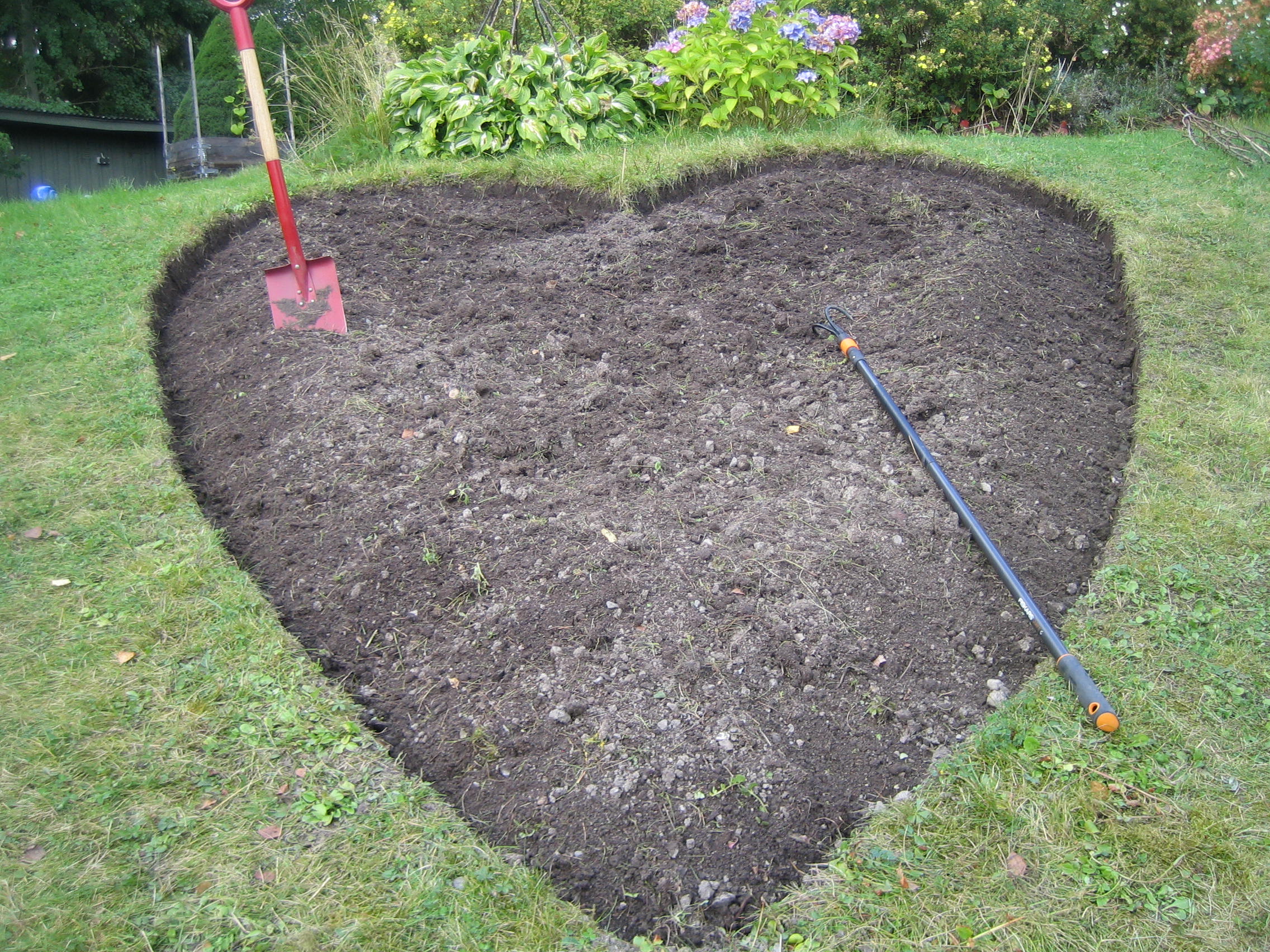
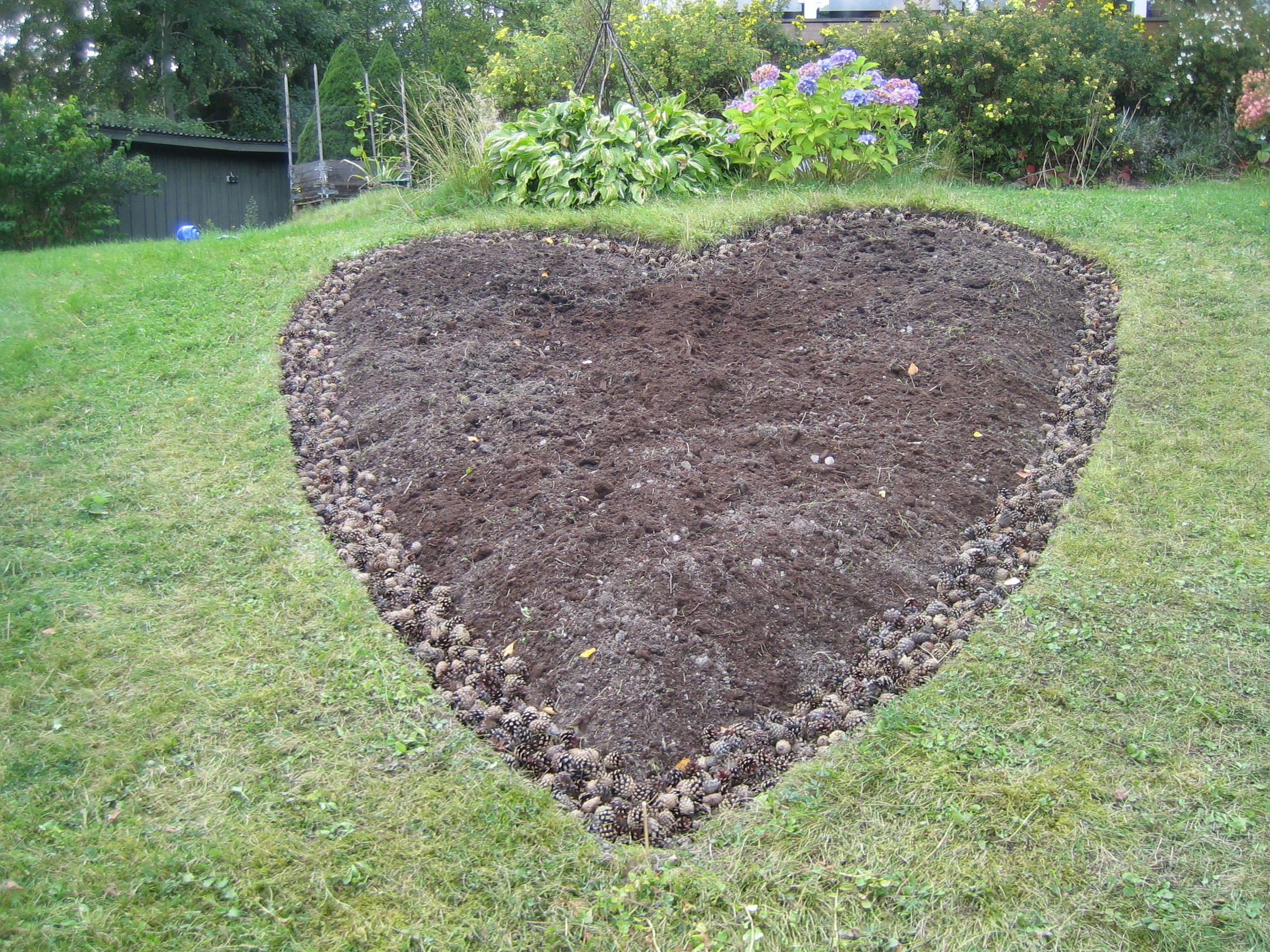
So how did I make this unusual flowerbed? I started measuring out the area. With sushi sticks. The size is about six yards high and four yards wide (5 x 3 meters). It took a while before I was satisfied.

The digging started. First I cut the edge of the heart with a spade, continuing with cutting out piece after piece of the lawn inside the heart. It took me nearly eight hours to dig the whole heart. There were a feIMG_0390IMG_0389w bigger and smaller stones that had to be coaxed out. It did not seem much, but when I looked at the heap of stones I realized it was.
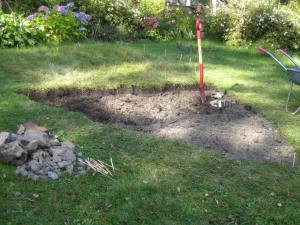
I don´t know how many loads with the wheelbarrow I drove from the heart and up to the compost. Loads that also emptied the heart of soil, so I needed to fill it with fresh soil. Six big bags of soil from the local store made the heart a cozy place for all the “tulip knights”.

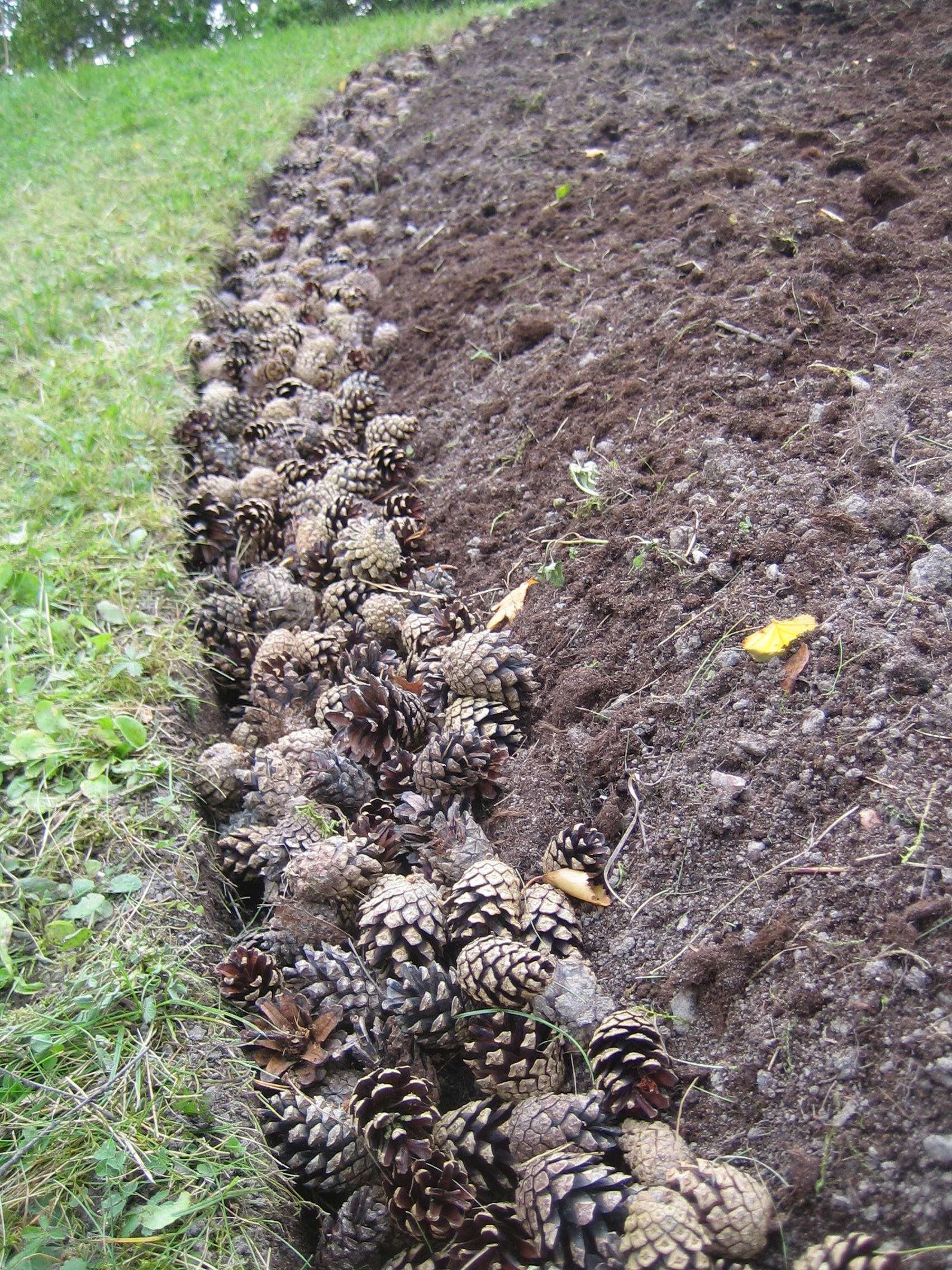
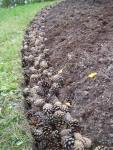
IMG_0392While I was busy planning, digging and filling with soil, our neighbour’s ten year old son helped me with some of the “bling bling”. I wanted to fill out the borders of the heart with pine cones. It looks nice, it makes it easy to see the border and I hope the cones with help stop the soil from being washed away by autumn rain.

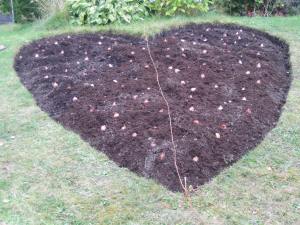
Now to the creative and artistic part. I put all the bags of tulips beside each other, just to admire and enjoy the colors of the photos. Also I divided the heart into two parts, a right and a leIMG_0400ft one with a piece of string between two sushi sticks. Every bag of tulips I shared equally between these parts of the heart, but was not so strict inside the parts, just spread the bulbs out more or less stochastically.
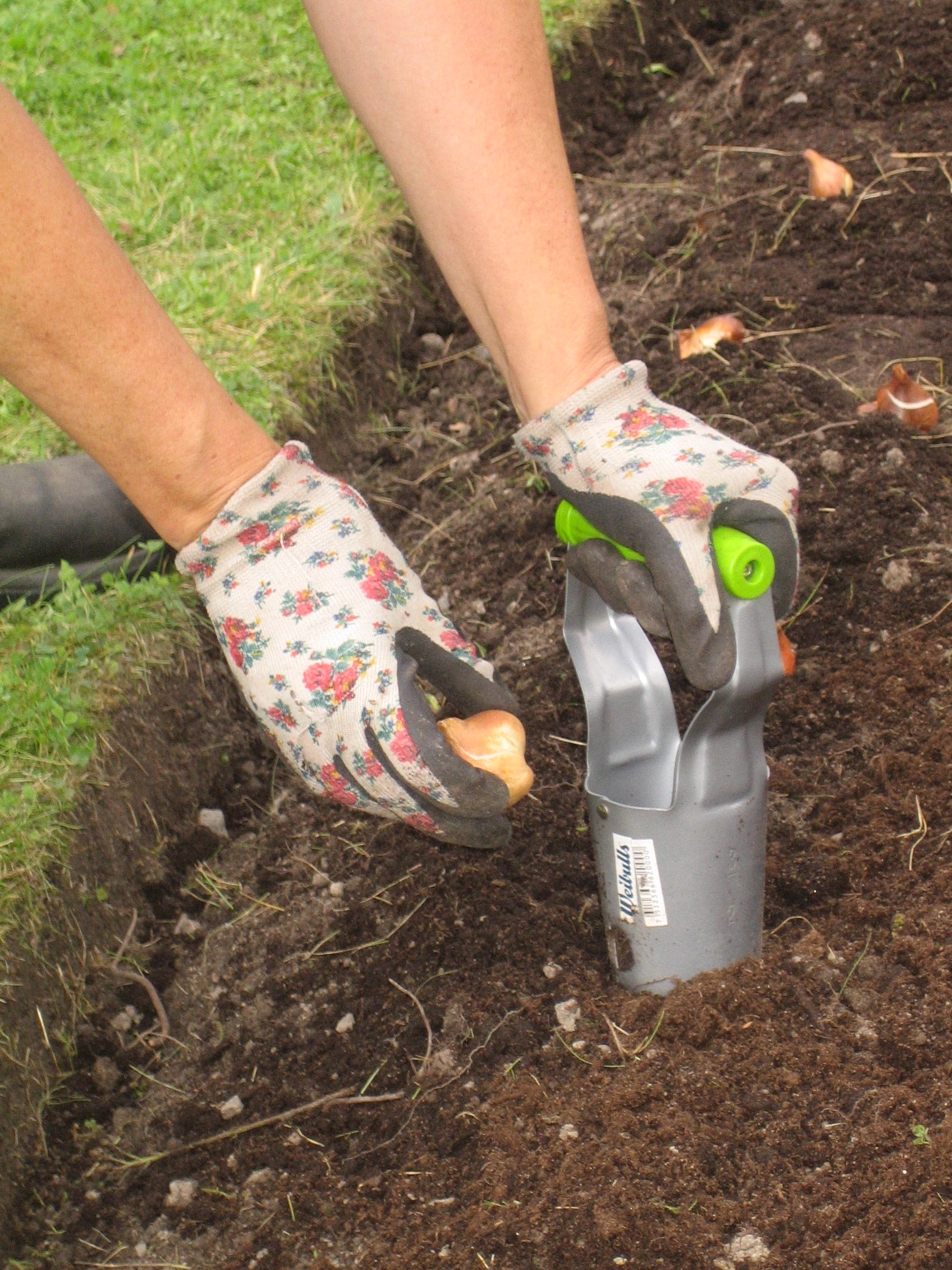
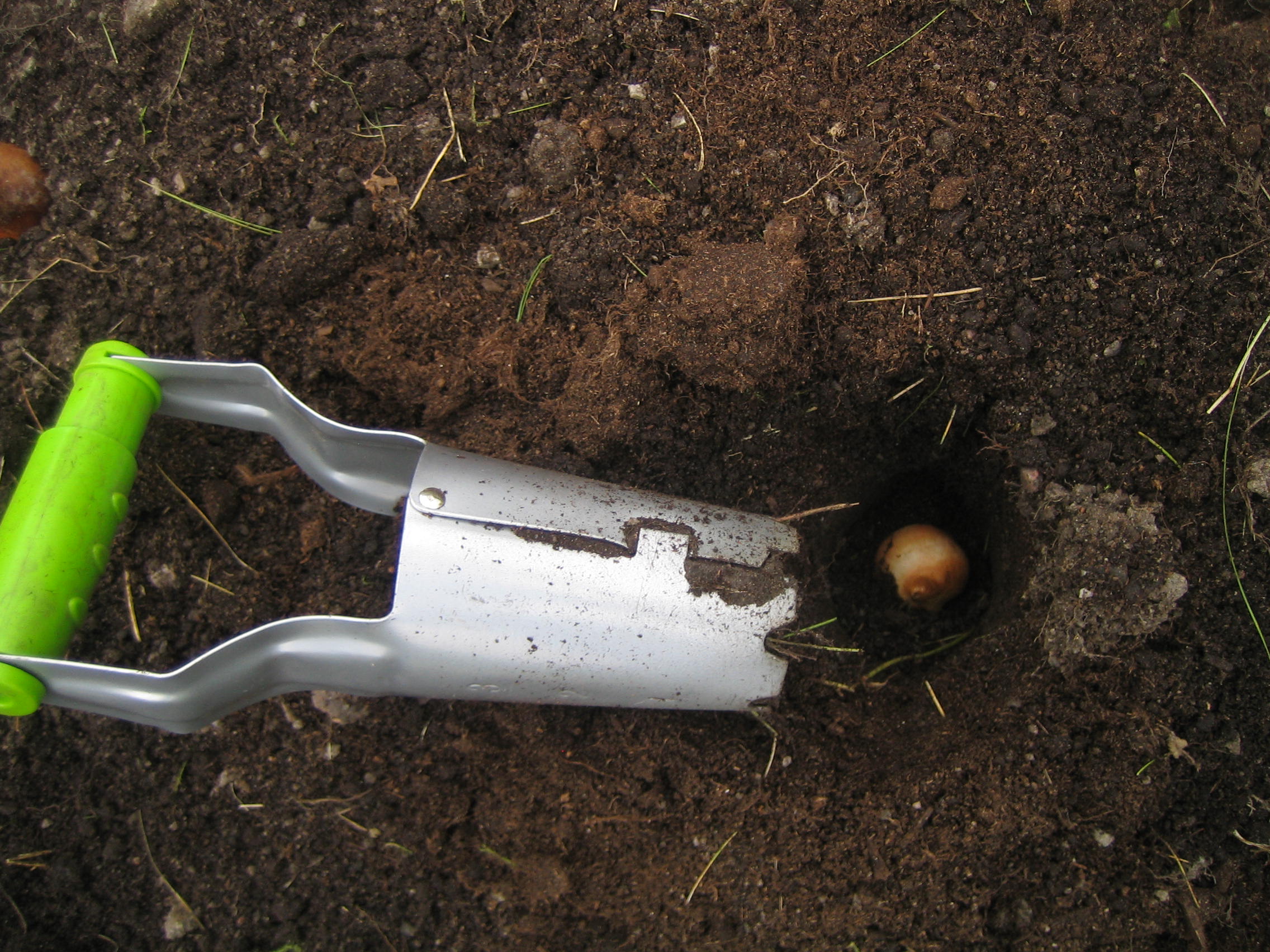
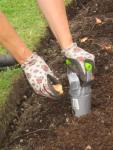
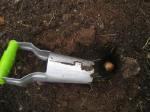
Planting was easy. In the planting store I found this very simple little scoop. You just press it down to the desired depth andIMG_0402 then pull – and all the soil follows, leaving a nice hole to put the bulb in. With the bulb in the hole, one presses the handles together and – whoops! – the soil in the scoop let go, covering the hole. I suppose many of you already know this toIMG_0406ol, but it was new to me and I was like a child with a new toy, playing down all the bulbs with a smile.
And this is the result! For protection, so the deers will not dig it up in the winter, I will put    cIMG_0408hicken wire over it. Also I am thinking of planting the new sprouts of strawberry I got this season, to make the heart a green bed. Hopefully the tulips will give joy in springtime,IMG_0407 and the new strawberries will give tasteful berries in June and July.
Competing for hazel nuts with squirrel

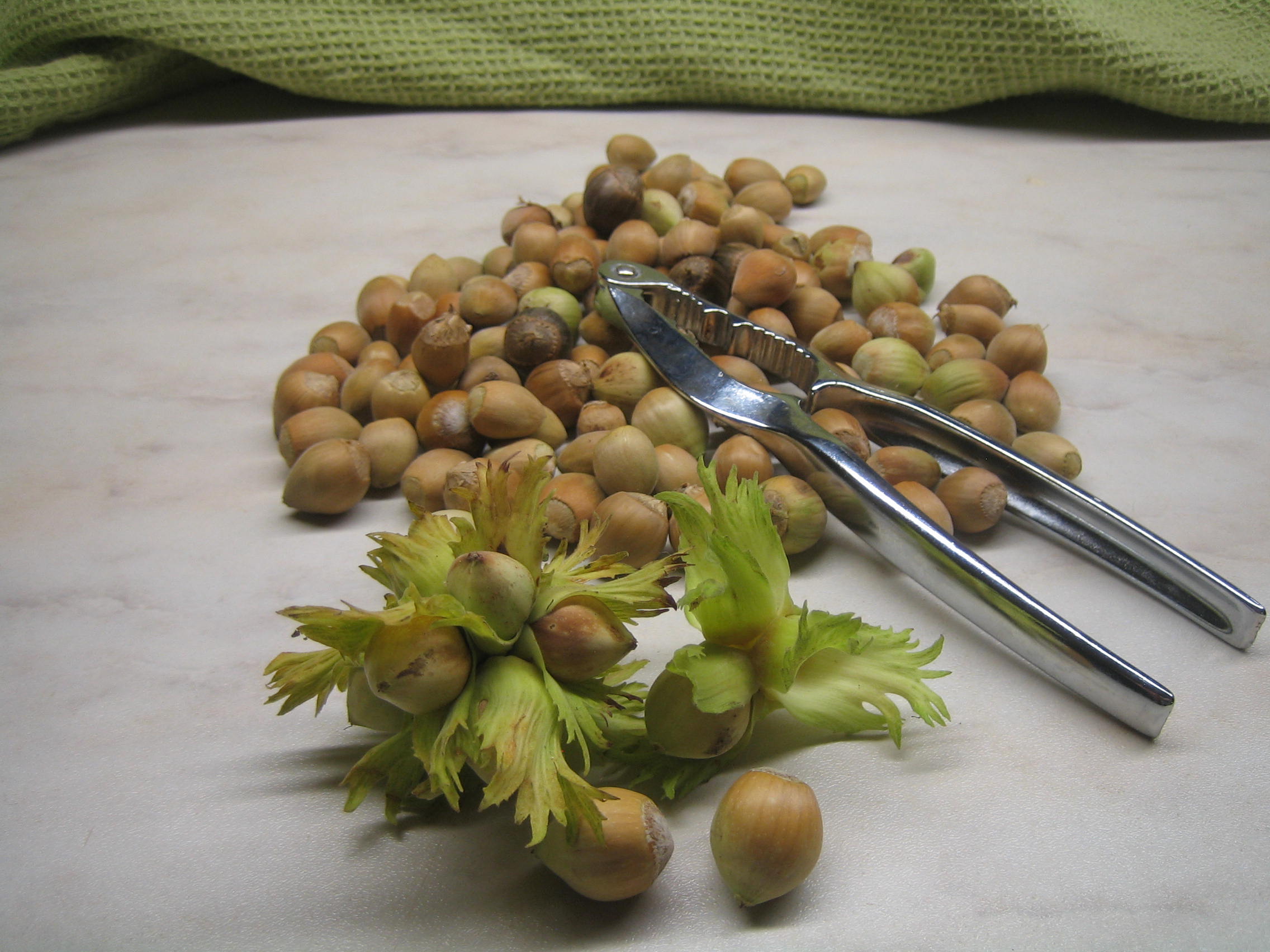
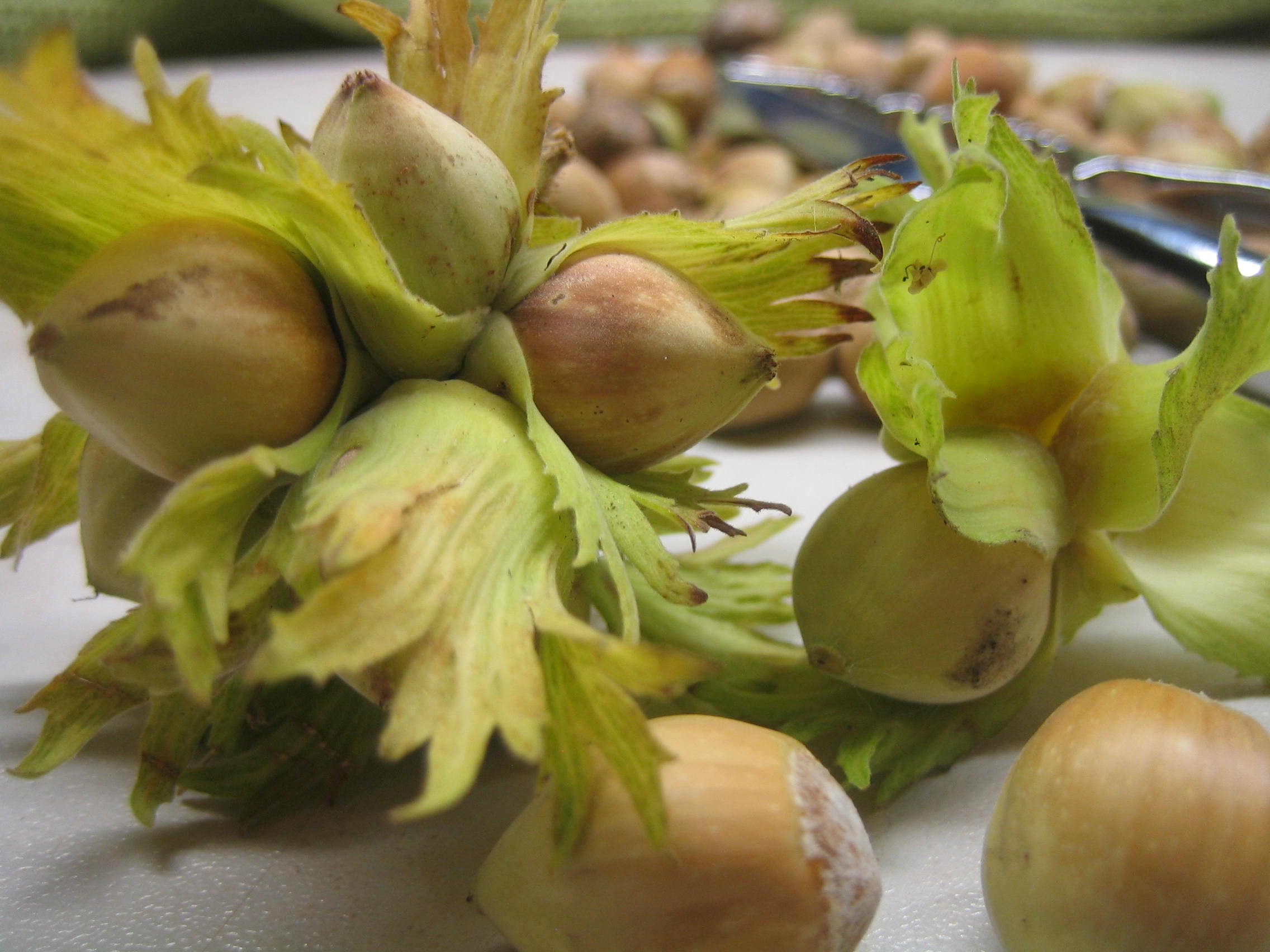
When we moved into our dream house three years ago, there were many plants and trees I did not know. We had a bunch of some mixture betweeIMG_0411n tree and bush growing next to one of the neighbours and I couldn´t figure out what it was. Until I saw a squirrel! Yes, of course, it was hazelnut! Full of nuts every summer. And strange enough, empty of them in September. Where did they all go? Well, I blamed the squirrel. Thought he had collected them all in a secret place for winter use.

Anyway, this autumn by chance I found out the hazelnuts let go of the tree and fall down to earth when they are ripe. Just like apples or any other fruit. In the grass under the hazelnut tree I found a lot of them. And I silently asked the squirrel to forgive me for accusing him. In fact, there was enough nuts for both him/her and me.

They are so beautiful how they grow, often sitting several of them together – and when ripe opening up their protective green shield to let the lime green nut IMG_0412fall out. Then, on a dry place, they will quickly turn brown. I will certainly save some for Christmas, to treat my friends and relatives with gardengrown hazelnuts.

Surprising gift on magical island

IMG_0365Autumn is a wonderful season, and I feel grateful for all the berries, fruits and vegetables I get to harvest. Everywhere I go in Sweden, I find something to enjoy of natures wealth.

We spent a week on the enchanting island of Gotland, in a sweet little cottage by the Baltic sea. We were so close to the water that we had this constant sound from the waves – to be honest it sounded like living by a highway road 🙂

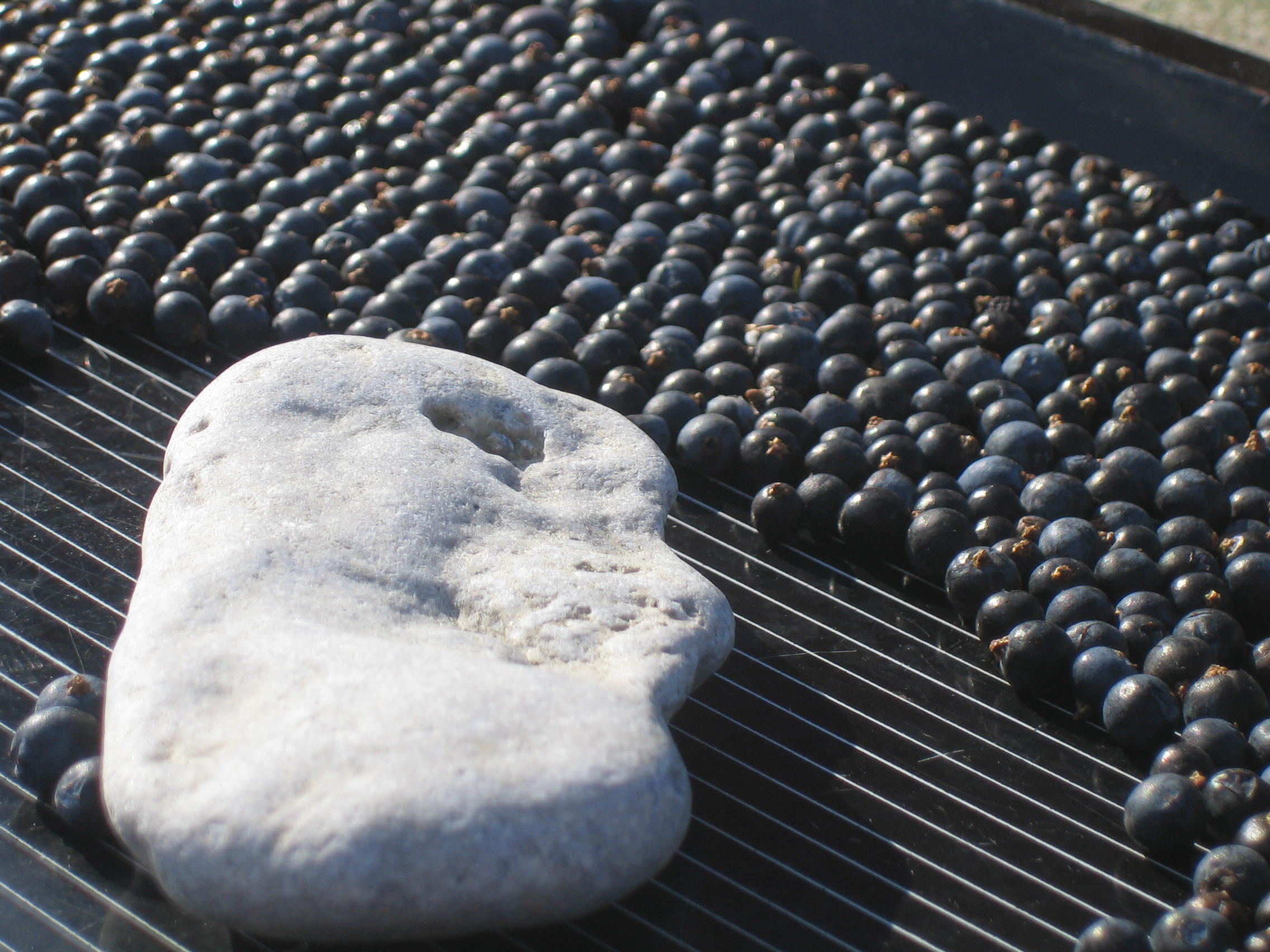
The first thing I saw on the property were all these juniper trees/bushes everywhere. When I looked closer I noticed there were a lot of ripe berries. The juniper is a strange tree/bush, because the berries need three years to get ripe. So on the same tree/bush you can find both ripe berries and berries in various stages of growth.

IMG_0364Anyway, I decided to pick some of the berries, to bring home and dry them and save them for later use. They are a delicious spice to use with for example lamb dishes.

The tree/bush is full of sticky needles, but the ripe berries were easy to pick. I just held a bowl underneath a twig and shaked the twig lightly – and all the ripe berries fell into the bowl. Now they are drying in the sun.
The beautiful white lime stones are found in
abundance on the shores of Gotland.

Hops for local beer brewing

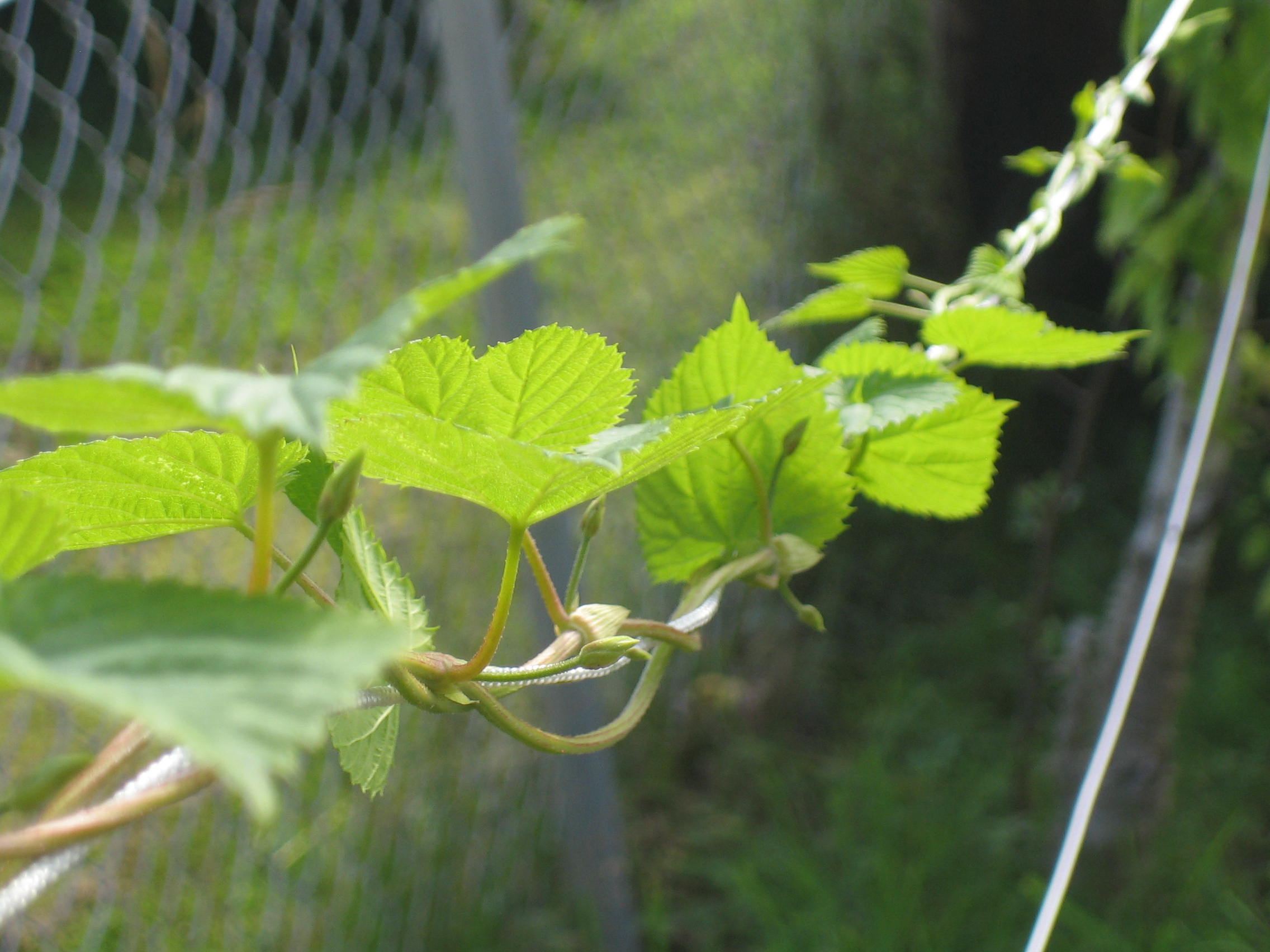
Interested in hops? Yes, I was, because of the rich and fastgrowing leaves. Then I talked to my beer brewing neighbour and he had a completely different interest in hops – he wanted it for beer brewing. So we knocked our heads togeIMG_0321ther and decided to have a joint hop project, where I would enjoy the hop leaves and he would harvest the hop flower. In January this year he ordered four roots of Cascade, a hop sort used for beer brewing, from England. He trusted me with bringing up the plants, while he has no experience in gardening.

I was a bit nervous to be granted this honor. Would I succeed? Our winter climat is rather tough and I have no green house. Well, interest and energy got me going, and I tended to the baby plants in my living room like they were my very small children.

After three months indoor, it was time for the now 6 inches tall plants to be acclimatized. I carried them out on the veranda every IMG_0324day and brought them indoor for the night.

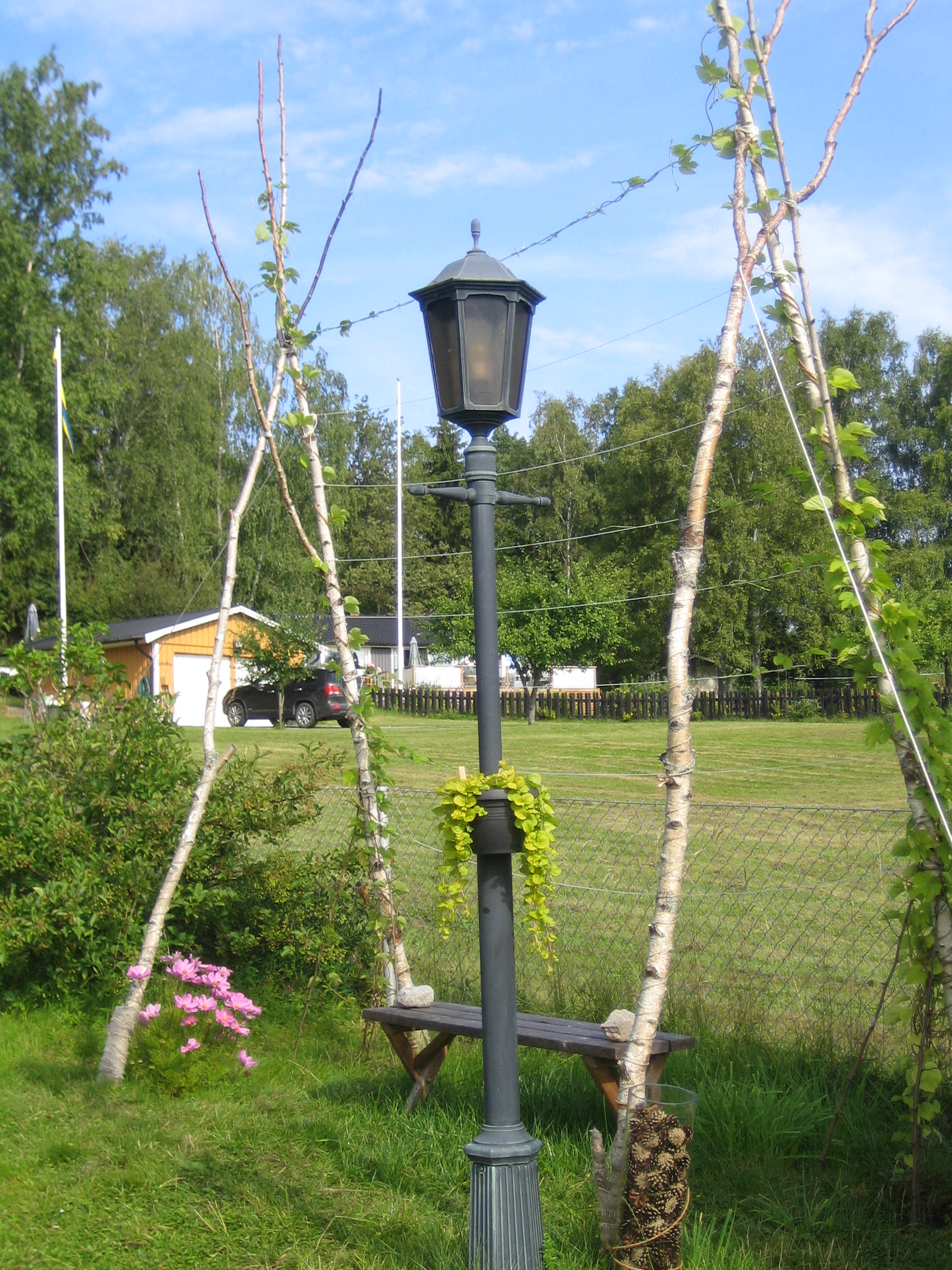
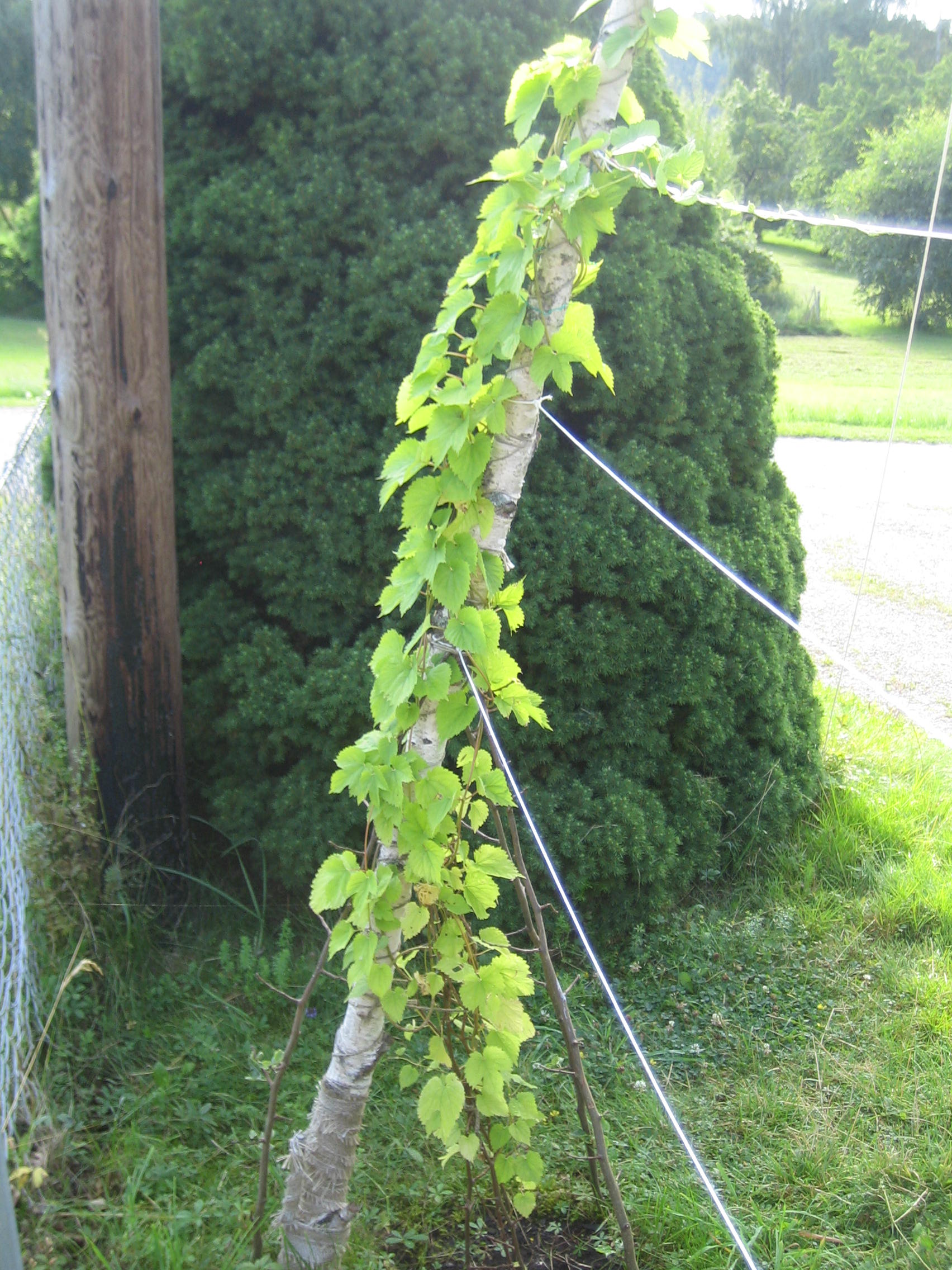
Beginning of June was the time for planting outside, in the garden. The neighbour only wanted to tend for one plant, the other three were in my care. Earlier that spring some neighbours had cut down young birch trees, and I asked if I could use them to build a special hops structure of my own. I used four trees, put them two and two in the form of a V and turned them upside down, then attached strings to them. Before my inner eye I saw a rich, secluded area with a bench, where I could relax and enjoy a cup of coffee.

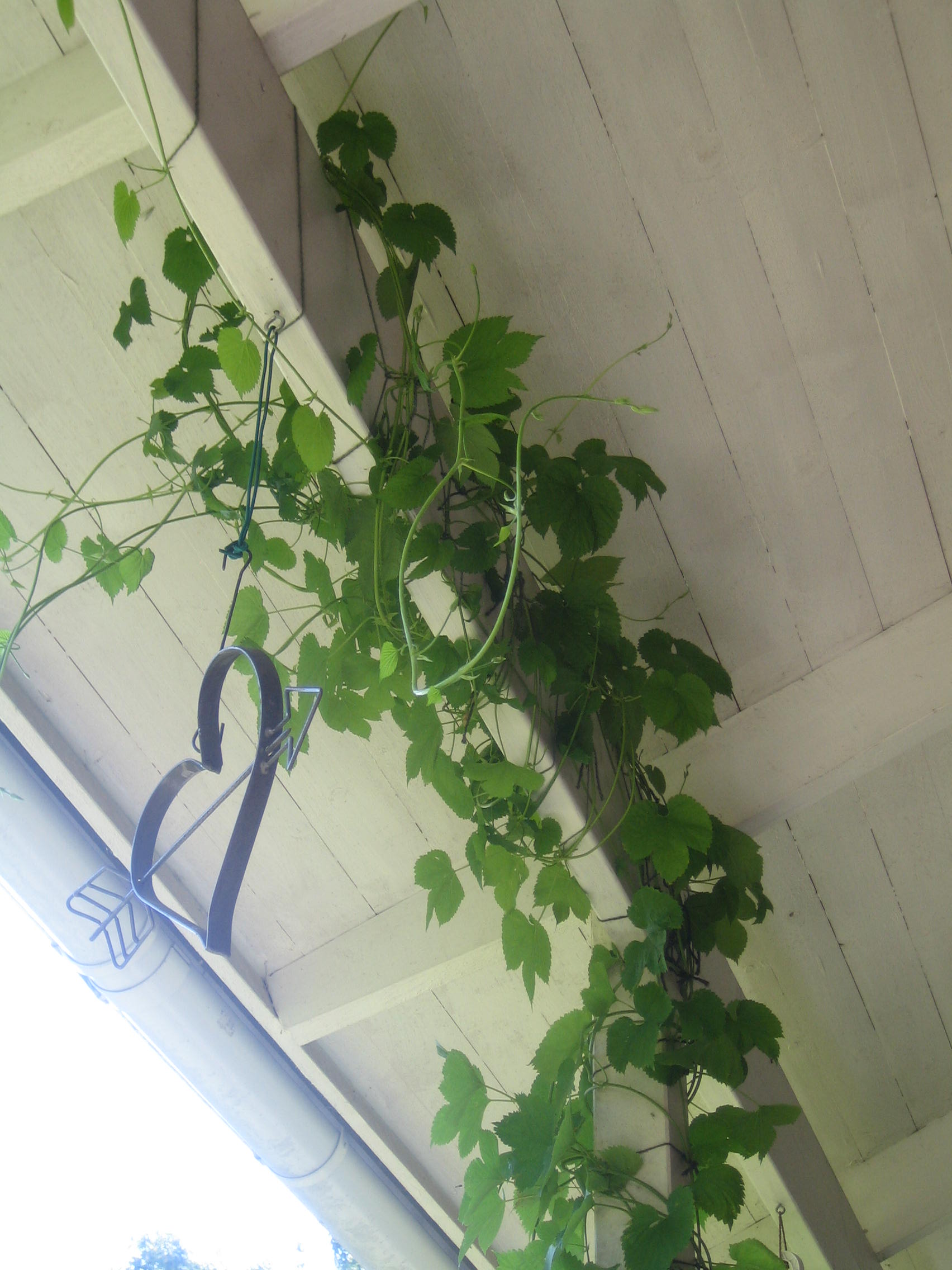
As you can see from the photos, this first year the plants are rather delicate. Beautiful, but not so filling in the structure. I don’t think we will have hops this year, but everyone IMG_0323in the hops business tell me the year 2 or 3 I will enjoy the richness of the hops. So patience is the most important ingredient in this business, it seems. The bench is there, and I can still have my coffee. But secluded … Not at all, yet. The third hop I planted in a pot on the veranda, and with protection from wind it grew a lot faster than the two down in the garden. Interesting to see the difference.

Anyway, a whole new world opened up with this hops planting. Neighbours I have never talked to, suddenly stop and discuss hops planting andIMG_0332 beer brewing. Since the hops structure is right by our IMG_0331entrance, everyone passing can watch the growing from close distance. And guess what – my favourite farm in the US, Skanda Equine (www.skandaequine.com) is starting a hop growing business! I like that very much, will be fun to share experiences.

Enjoy the photos and get inspiration – and perhaps a future homebrewed beer 🙂